How Truckers Can Save Money on Fuel
Learn how to save money on fuel for truckers through better buying decisions, route planning, speed control, maintenance, idle reduction, fuel tracking, and disciplined driving.
How Can Truckers Save Money on Fuel?
Truckers can save money on fuel by improving miles per gallon, reducing unnecessary miles, limiting idle time, maintaining correct tire pressure, managing speed and acceleration, planning fuel stops by net price, using the right fuel card or discount program, preventing theft, and tracking cost per mile. The best results usually come from combining purchasing savings with operational efficiency rather than relying on one large advertised discount.
Practical rule: measure savings in dollars per mile and total monthly fuel cost—not only cents per gallon.
Where Should an Owner Operator Start?
Compare the final card price, cash price, fees, detour cost, and route before purchasing diesel.
Control speed, idling, tire pressure, maintenance, aerodynamics, and driver habits.
Improve routing, backhauls, dispatch decisions, parking plans, and deadhead management.
17 Smart Ways Truckers Can Save Money on Fuel
The exact impact varies by truck, route, load, weather, driver, equipment, and starting efficiency. Use your own data to confirm results.
Compare the final net fuel price
Compare what you would actually pay with cash, the fuel-card transaction price, all fees, and any detour cost. A large discount from a high base price can still be expensive.
High impact · Easy to startUse a fuel card that matches your routes
A strong card is one whose discounted network overlaps with your regular lanes. Acceptance alone does not guarantee a discount or fee-free transaction.
High impact · Route dependentKeep a second discount option available
An app-based or secondary fuel program can provide a better price when the main card’s preferred network is unavailable or off route.
Medium impact · FlexiblePlan fuel stops before the trip
Choose stops based on net price, route, parking, hours, traffic, tolls, and available gallons. Last-minute purchases usually reduce bargaining power.
High impact · Low costAvoid detours that erase the discount
Calculate the round-trip miles, time, idling, and tolls required to reach the cheaper stop. The lowest sign price is not always the lowest trip cost.
Medium impact · Common mistakeManage highway speed
Higher speed increases aerodynamic resistance and fuel demand. Choose a safe, legal, consistent operating speed that balances schedule requirements with fuel economy.
High impact · Driver controlledAccelerate and brake smoothly
Rapid acceleration, hard braking, and repeated speed changes waste energy. Driver coaching and feedback tools can make efficient behavior easier to repeat.
High impact · Training requiredReduce unnecessary idling
Long-duration idling burns fuel without moving freight. Use auxiliary power, bunk heaters, truck-stop electrification where available, and shutdown policies that fit weather and safety needs.
High impact · MeasurableMaintain correct tire pressure
Underinflated tires increase rolling resistance, heat, wear, and fuel use. Check pressure cold and follow the tire and vehicle specifications.
Medium impact · Safety benefitUse low-rolling-resistance tires when appropriate
SmartWay-verified tire technologies are designed to reduce rolling resistance. Compare expected savings with traction, durability, route, replacement cost, and maintenance needs.
Medium impact · Equipment choiceMaintain the engine and aftertreatment system
Follow service intervals for filters, fluids, cooling, injectors, sensors, alignment, and emissions equipment. Small mechanical problems can gradually reduce MPG.
High impact · PreventiveImprove tractor and trailer aerodynamics
Properly fitted fairings, side skirts, gap reducers, wheel covers, and trailer-tail devices can reduce drag at highway speed. Inspect them regularly.
Highway impact · Equipment investmentReduce unnecessary weight
Remove equipment, materials, chains, tools, and supplies that are not required for the load, route, weather, safety, or compliance.
Low to medium · Easy reviewReduce deadhead miles
Use better dispatch planning, backhauls, triangular routing, appointment coordination, and market knowledge to avoid moving an empty truck farther than necessary.
Very high · OperationalTrack MPG and cost per mile
Record odometer miles, gallons, transaction price, fees, idle hours, route, load, and driver. Weekly trends reveal slow declines that a single receipt cannot show.
Foundational · Data drivenPrevent fuel theft and unauthorized purchases
Use PINs, vehicle assignment, product limits, gallon limits, time and location restrictions, alerts, and reconciliation against tank capacity and miles driven.
Risk control · Fleet essentialTrain drivers and reward measurable improvement
Set realistic targets for idle time, speeding, harsh events, route compliance, MPG, and receipt accuracy. Reward verified improvement without encouraging unsafe driving.
High impact · Long term
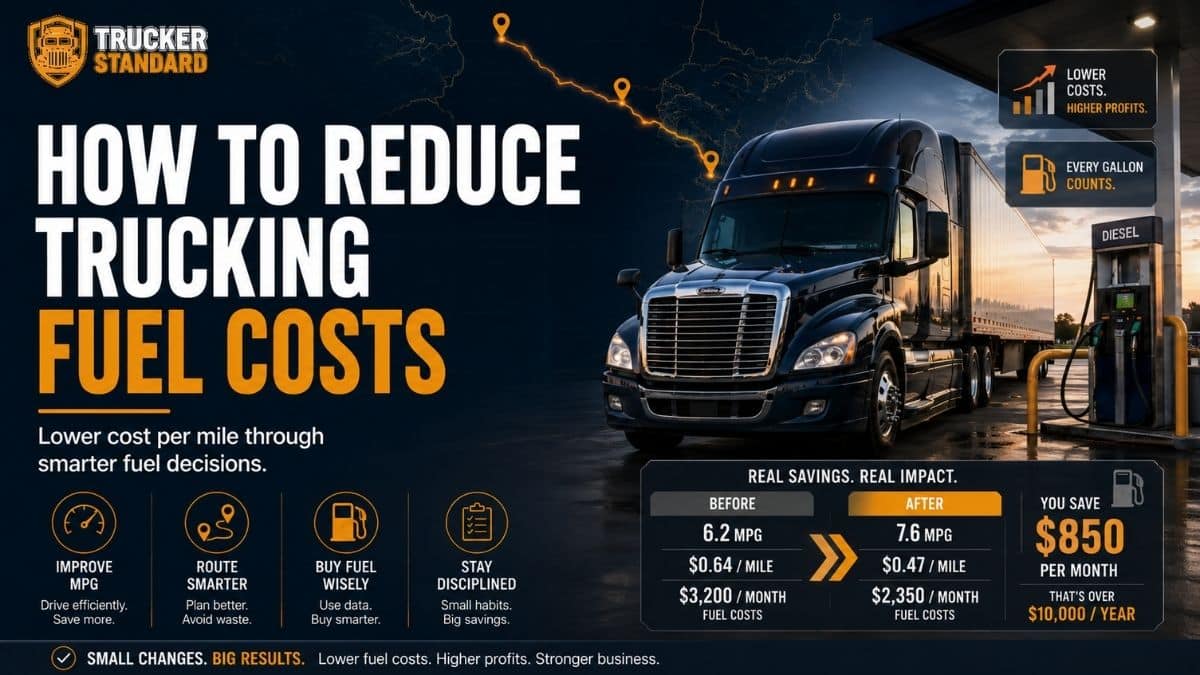
How a Small MPG Improvement Changes Fuel Cost
This simplified example assumes the same miles and diesel price. It does not include taxes, fees, maintenance, or route differences.
Fuel Metrics Every Owner Operator Should Track
Total miles divided by gallons purchased, reviewed by truck, driver, route, and load type.
Total fuel spend, including card fees, divided by total business miles.
Track long-duration idle time and compare it with weather, stops, detention, and driver patterns.
Empty miles divided by total miles. High deadhead can erase improvements at the pump.
Use the final paid price after discounts, rebates, transaction charges, and account fees.
Review out-of-network purchases, unusual gallons, premium products, duplicate charges, and mismatched vehicles.
Fuel-Saving Mistakes That Can Cost More
- Driving extra miles for a discount smaller than the detour cost.
- Reducing speed in a way that creates unsafe traffic behavior.
- Underinflating or overinflating tires to chase fuel economy.
- Skipping maintenance because the truck still appears to run normally.
- Removing safety, emergency, securement, or compliance equipment to reduce weight.
- Buying aerodynamic equipment without verifying fit and duty cycle.
- Rewarding MPG alone without considering safety, weather, load, and route.
- Comparing drivers without normalizing for operating conditions.
Compare Fuel Cards and Discount Programs
Before changing equipment, confirm whether your current payment method is producing the lowest net price on the lanes you already run.
Make Better Fuel-Buying Decisions
Learn which monthly, transaction, network, transfer, and penalty charges can reduce savings.
Compare final price, reporting, controls, credit structure, and cash-flow timing.
Review prepaid, cash-secured, and pay-as-you-go options for new carriers.
How to Save Money on Fuel for Truckers FAQ
What is the fastest way for a trucker to save money on fuel?
The fastest starting point is to compare the final net fuel price at stops already on the route, eliminate unnecessary detours and idling, verify tire pressure, and begin tracking MPG and fuel cost per mile.
How much fuel does a semi-truck use while idling?
Fuel use varies by engine, load, weather, accessories, and operating conditions. U.S. Department of Energy guidance says idling can use roughly one-quarter to one-half gallon per hour for vehicles generally, while heavy-duty equipment should be monitored using actual engine or telematics data.
Does driving slower save diesel in a semi-truck?
Reducing excessive highway speed can lower aerodynamic demand and fuel use. The safest and most useful target depends on the speed limit, traffic, terrain, schedule, load, gearing, and company policy.
How does tire pressure affect truck fuel economy?
Underinflation increases rolling resistance, heat, tire wear, and fuel use. Drivers should use the specifications appropriate for the tire, axle load, wheel, and vehicle rather than guessing or using a universal pressure.
Are aerodynamic devices worth it for owner operators?
They can be valuable for trucks that spend substantial time at highway speed. The result depends on device quality, installation, trailer gap, route, speed, maintenance, and annual miles.
Is the cheapest fuel stop always the best choice?
No. Add detour miles, tolls, idling, time, card fees, base price, and the amount of fuel purchased. A closer stop with a slightly higher price can have a lower total trip cost.
What fuel metrics should an owner operator track?
Track miles, gallons, MPG, net price per gallon, fuel cost per mile, idle hours, deadhead miles, out-of-network purchases, card fees, and unusual transactions.
Can fuel cards reduce trucking fuel costs?
Yes, when the card’s discounted locations match the route and the final price after fees is lower than the available cash or alternative card price. A fuel card can also improve controls, receipts, reporting, and fraud detection.
Official Sources Reviewed
- U.S. Department of Energy — Efficient driving, speed, acceleration, braking, and driver feedback
- Alternative Fuels Data Center — Maintenance, tire pressure, and efficient driving
- Alternative Fuels Data Center — Heavy-duty truck idle-reduction technologies
- Alternative Fuels Data Center — Auxiliary power and truck-stop electrification
- U.S. EPA SmartWay — Truck aerodynamics, tires, and idle-reduction technology
- U.S. EPA SmartWay — Verified aerodynamic-device savings categories
- U.S. EPA SmartWay — Designated tractor and trailer efficiency
- U.S. EPA SmartWay — Driver training and carrier efficiency resources