Fuel Card vs Cash for Truckers
Compare fuel card vs cash by net price, fees, route access, fraud protection, reporting, payment terms, and the actual needs of your trucking business.
Is a Fuel Card Better Than Paying Cash?
A fuel card is usually better for truckers who can obtain a lower net price on their routes and benefit from driver controls, digital receipts, reporting, fraud protection, or delayed payment. Cash can be better when a station’s cash price is lower than the card’s final price, the card adds fees, the discount network requires a costly detour, or the carrier makes only occasional fuel purchases.
Bottom line: neither option wins every time. Compare the net transaction cost and operational value at each route and station.
Fuel Card vs Cash: Which One Wins?
Fuel Card Usually Wins When
The card creates both measurable fuel savings and useful operating controls.
- The discounted card price is lower after every fee.
- Your trucks fuel frequently across several states.
- You need driver limits, purchase controls, or fraud alerts.
- Digital receipts and IFTA-ready reports save administrative time.
- Credit or billing terms improve short-term cash flow.
Cash Usually Wins When
The posted cash price remains lower after card discounts and charges.
- The station offers a strong cash discount or card surcharge.
- You fuel infrequently and fixed card fees are hard to recover.
- The card’s preferred network is far from your route.
- You do not need fleet controls or detailed reporting.
- You want to avoid credit terms and can safely manage payment.
9 Key Differences Between a Fuel Card and Cash
Price at the pump
May use a negotiated cost-plus price, retail-minus discount, rebate, or partner rate.
May receive the station’s posted cash price, which can be below the credit price.
Fees and surcharges
Can include monthly, per-card, transaction, network, transfer, or late fees.
Usually avoids card-program fees, but withdrawal, handling, security, or bookkeeping costs may remain.
Discount consistency
Network prices can be visible in an app before the driver arrives.
The price depends on the station and can change without a guaranteed network discount.
Cash flow timing
A credit or charge card may delay settlement; prepaid and cash-secured cards do not.
The money leaves immediately and does not create a later balance or payment deadline.
Fraud and driver controls
Can restrict products, locations, gallons, times, drivers, vehicles, and transaction amounts.
Has limited built-in controls and is difficult to recover after loss or misuse.
Receipts and reporting
Automatically records date, location, gallons, product, driver, vehicle, and price.
Requires the driver to preserve and correctly submit each paper or digital receipt.
IFTA and accounting
Many products provide downloadable jurisdiction and transaction reports.
Records must be entered manually unless another app captures the purchase.
Route flexibility
May be widely accepted, but the strongest discount can be limited to a smaller network.
Works where cash is accepted and lets the driver use whichever nearby station is cheapest.
Business credit and privacy
Some credit products may report payment activity; the account also creates detailed transaction records.
Does not build business credit and provides less automated transaction visibility.
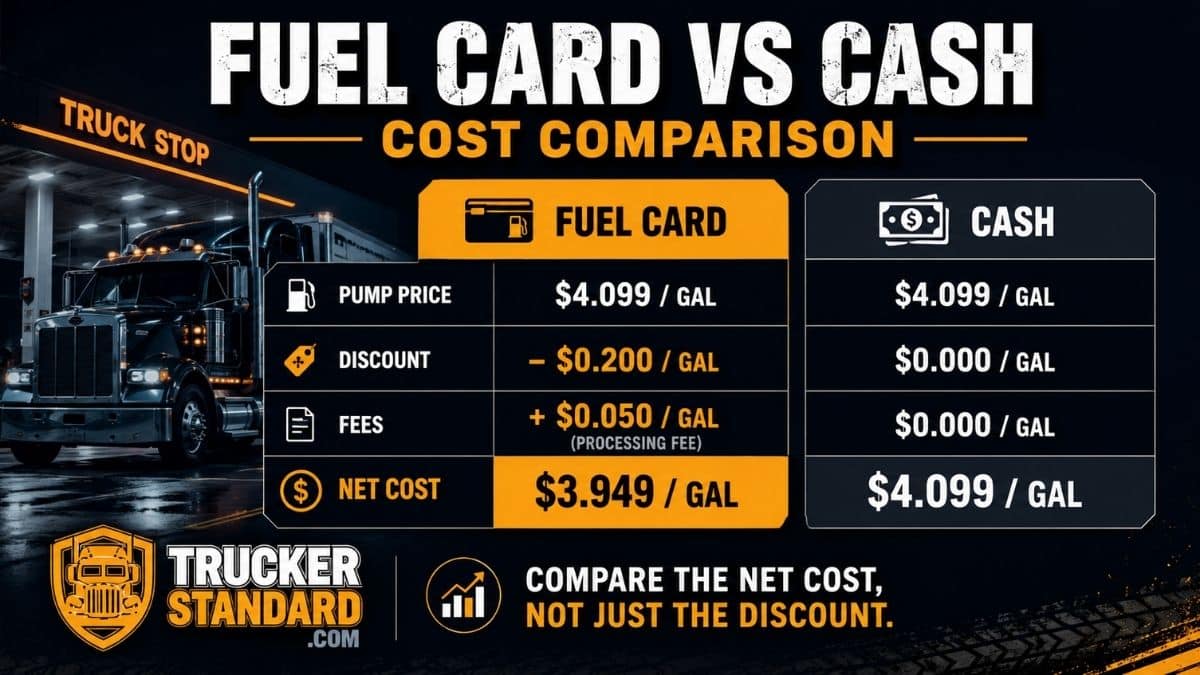
Fuel Card vs Cash Cost Comparison
This example is illustrative. Replace every number with prices and fees from your route.
Cash Price, Credit Price, and Fuel-Card Price Are Different
At some truck stops, three prices can exist at the same time.
The price offered for cash or an eligible cash-equivalent method. It can be lower than the posted credit price.
The price charged to an ordinary credit card and sometimes displayed separately from cash.
A negotiated network price that may be below cash, equal to cash, or above cash after fees.
Compare Against the Payment Method You Would Really Use
A claim that a card saves 30¢ against the credit price is less useful when you would have paid the lower cash price. Use the correct baseline.
Review Fuel Card Hidden FeesWhen Should Truckers Use a Fuel Card or Pay Cash?
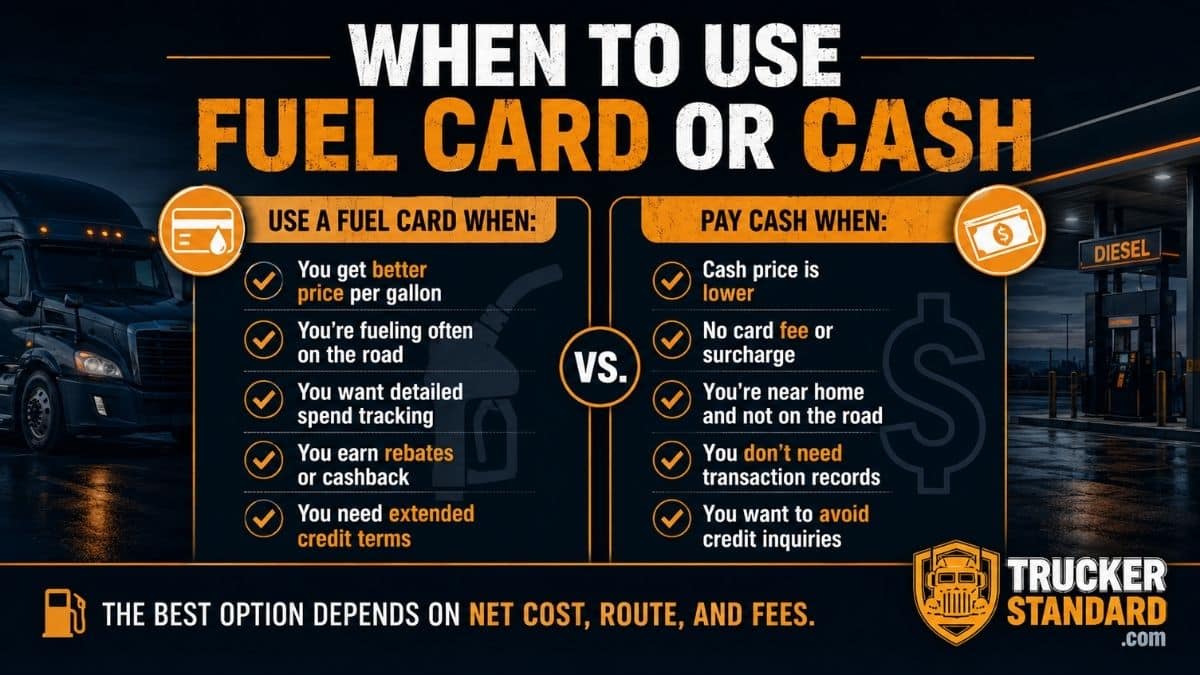
Use a Fuel Card When
- The net card price is below the cash price on your route.
- The card’s discount stops fit existing lanes without a large detour.
- You manage multiple trucks, drivers, or business purchases.
- You need automatic receipts, reports, controls, and fraud alerts.
- Billing terms provide useful cash-flow time without expensive fees.
- The total monthly savings comfortably exceed every card charge.
Pay Cash When
- The station’s cash price is lower than the card’s final net price.
- You make an occasional fill and cannot recover monthly account fees.
- The preferred card network would require extra miles, time, or tolls.
- The card is unavailable or triggers an out-of-network fee.
- You can maintain reliable receipts and expense records manually.
- You want to avoid a credit balance, late-payment risk, or account restrictions.
How Payment Timing Changes the Comparison
The carrier uses available money immediately. There is no later bill, but working cash falls at once.
The carrier funds the account before fueling. It improves control but does not create extra credit time.
The account may delay settlement, but payment deadlines, limits, underwriting, and penalties matter.
Do Not Pay More Only to Delay Payment
Compare the value of extra payment time with card fees, interest, penalties, and alternative working-capital options.
Compare Factoring vs Waiting for PaymentCommon Fuel Card vs Cash Comparison Mistakes
- Comparing the card discount with the credit price instead of the available cash price.
- Ignoring monthly, transaction, network, funding, and late fees.
- Driving extra miles for a discount smaller than the detour cost.
- Assuming every location that accepts the card offers the same discount.
- Treating prepaid cards as if they provide credit terms.
- Ignoring the value of receipts, controls, reports, and fraud reduction.
- Paying cash without a reliable receipt and record process.
- Using one payment rule for every route, station, and truck.
Compare Cards Using Your Actual Routes
Look for a fuel card whose discount network matches your lanes, whose charges are transparent, and whose final price beats cash often enough to justify the account.
Continue Your Fuel Cost Research
Compare discounts, networks, fees, acceptance, controls, and fleet fit.
Review monthly, transaction, network, transfer, late, and replacement charges.
Explore prepaid, cash-secured, and pay-as-you-go fuel options.
Fuel Card vs Cash FAQ
Is it cheaper for truckers to use a fuel card or pay cash?
It depends on the station and card. A fuel card is cheaper when its final transaction price plus allocated fees is below the cash price. Cash is cheaper when the station’s cash discount exceeds the card’s net savings.
Do fuel cards receive the cash price?
Some trucking fuel cards state that accepted locations charge no more than the cash price, while preferred-network stops may provide an additional discount. Policies vary by product and location, so verify the final app or transaction price.
Why is the cash price lower than the credit price?
Some stations use separate cash and credit pricing to account for payment-processing costs or to encourage immediate payment. The difference varies by merchant and location.
Are fuel-card discounts worth the fees?
They are worth it when realized monthly fuel savings and operational benefits exceed monthly, per-card, transaction, network, funding, financing, and penalty costs.
Does a prepaid fuel card improve cash flow?
A prepaid card can improve budgeting and control, but it does not delay payment because the carrier supplies the funds before purchasing fuel. A credit or charge card may provide more payment time.
Is cash safer than a fuel card?
Cash avoids account or card fraud but can be lost, stolen, or misused with limited recovery. Fuel cards can provide PINs, limits, product restrictions, alerts, and transaction records, although card fraud and account compromise remain possible.
Are fuel-card reports useful for IFTA?
Many trucking fuel cards record gallons, date, location, state, vehicle, and driver information that can support IFTA reporting. The carrier should confirm the report includes the fields required by its process and retain valid records.
Can a trucking company use both a fuel card and cash?
Yes. A carrier can use its fuel card where the net price and controls are advantageous, then pay cash when a station offers a lower final price or the card network does not fit the route.
Official Sources Reviewed
- TCS — Cash-price policy, in-network discounts, fees, and acceptance
- TCS — Fuel-card controls, reporting, PINs, and transaction workflow
- TCS — Published savings and cash-secured card structure
- Mudflap — Why net price after discounts and fees matters
- Mudflap — Pay-as-you-go discounts, digital receipts, and IFTA reporting
- WEX — EFS acceptance, controls, and integration
- WEX — Fleet-card acceptance network
- AtoB — Fuel-card savings, fees, controls, and cost considerations