Fuel Card Hidden Fees Truckers Should Avoid
Learn which fuel card charges can reduce trucking savings, how to calculate the true cost per gallon, and what to ask before accepting a discount offer.
What Fuel Card Hidden Fees Should Truckers Watch For?
The most common fuel card hidden fees are setup charges, monthly account fees, per-card fees, transaction fees, out-of-network charges, late-payment penalties, declined-transaction fees, ACH or wire fees, replacement-card costs, inactivity fees, and minimum-volume requirements. A fuel card can advertise a large discount and still deliver weak savings after these charges are divided across the gallons purchased.
Important distinction: a fee is not automatically deceptive simply because it is easy to overlook. The problem is failing to include every disclosed charge in the total-cost comparison.
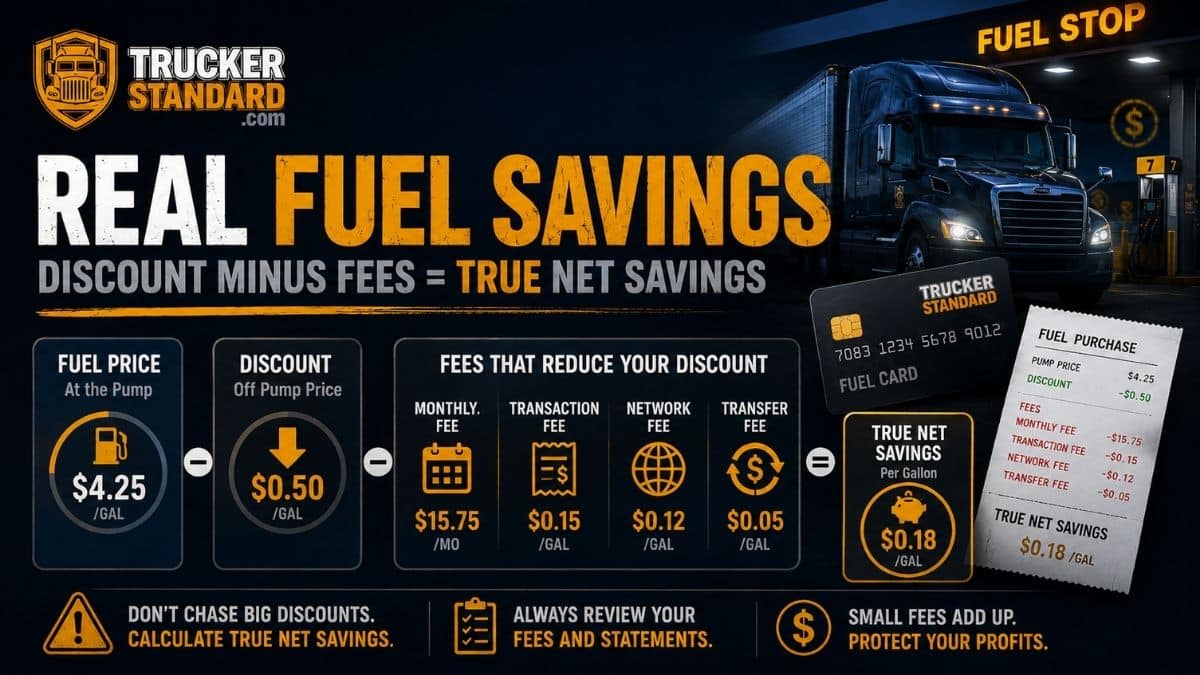
Fuel Card Discount vs Real Net Savings
The advertised cents-per-gallon figure is only one part of the calculation.
11 Fuel Card Hidden Fees to Review
Request the current fee schedule and cardholder agreement. Do not rely only on a salesperson’s statement that there are “no hidden fees.”
Setup or enrollment fee
A one-time charge to open the account, perform onboarding, or issue the first cards. It matters most when the fleet is small or the account may be used briefly.
Ask: Is there any account-opening, implementation, or enrollment charge?Monthly account fee
A recurring plan or maintenance cost that applies even during low-volume months. Divide it by monthly gallons to see its cost per gallon.
Ask: Is the fee per account, per plan, or per vehicle?Per-card fee
A monthly or annual charge for each active driver card. Unused cards can continue creating costs unless they are deactivated.
Ask: Are inactive, virtual, replacement, and spare cards billed?Fuel transaction fee
A flat charge added each time a driver fuels. Frequent small fills can make this more expensive than fewer large transactions.
Ask: Does the fee apply per swipe, per invoice, per location, or only outside the preferred network?Out-of-network fee
An extra flat or per-gallon charge when fueling outside selected locations. Some cards are widely accepted but discount only a smaller network.
Ask: Which stations are accepted, and which stations are fee-free and discounted?Late-payment fee
A fixed charge or percentage of the overdue balance. Weekly billing cycles can create penalties faster than a carrier expects.
Ask: What is the due date, grace period, penalty formula, and returned-payment charge?Declined-transaction fee
A charge triggered when a purchase is rejected because of insufficient funds, driver limits, merchant controls, or account status.
Ask: Can a failed authorization create a fee even when no fuel is purchased?ACH, wire, or reload fee
A cost to fund a prepaid account, move money, make an expedited payment, or receive a wire. Percentage-based reload fees can be especially expensive.
Ask: Which funding method is free, and how long does it take to become available?Replacement or rush-card fee
Lost, stolen, damaged, or urgently shipped cards can create issuance and delivery charges.
Ask: What does standard replacement cost, and what is the expedited-shipping charge?Inactivity fee
A charge after a card or account is unused for a specified period. Seasonal carriers and spare cards are particularly exposed.
Ask: How long can an account or card remain unused before charges begin?Minimum-volume or discount threshold
The account may require a minimum number of gallons or monthly spend to avoid a fee or qualify for the advertised rebate.
Ask: Is the published discount guaranteed, tiered, capped, or dependent on volume?Non-fee costs
Detours, tolls, idling, lost driving time, higher pump prices, and reduced loyalty rewards can also reduce the economic value of a card.
Ask: Would I still choose this station if the card discount did not exist?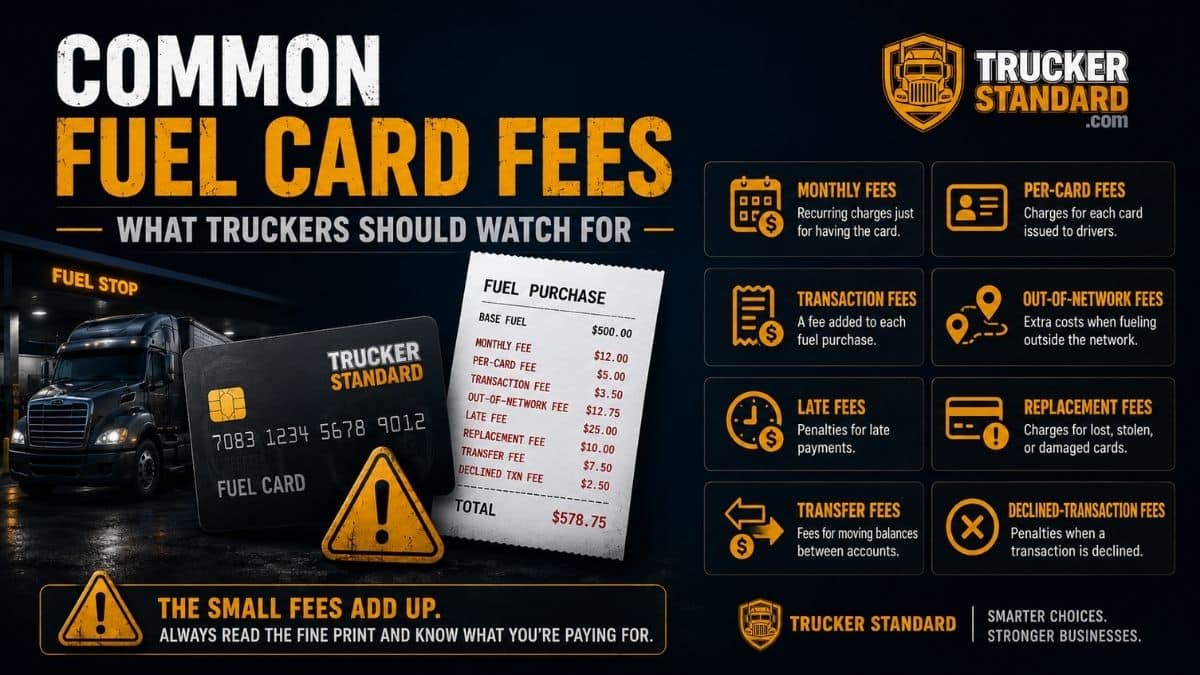
How to Calculate Real Fuel Card Savings After Fees
This example is illustrative. Replace each number with your actual statement, route prices, and gallons.
Why You Must Compare the Exact Product
Different products from the same provider can have different pricing. The examples below illustrate why the product name and fee schedule matter.
AtoB
AtoB publishes product-specific pricing. Its materials describe prepaid pricing around $3 per active card monthly, a setup charge on some products, and late-payment penalties for credit accounts. A fee-free promotional or partner program should not be assumed to represent every AtoB account.
Confirm the specific AtoB product, setup fee, card fee, billing cycle, and late-payment formula.Fuelman
Fuelman publicly lists monthly plan prices rather than presenting every plan as free. Its diesel products currently show Basic, Pro, and Enterprise tiers, so a small fleet should compare the recurring plan cost with expected gallons and rebates.
A recurring account fee can consume much of a low-volume fleet’s advertised per-gallon saving.Fleet One EDGE
WEX states there is no transaction fee at EDGE Discount Sites and Fleet One Discount in-network locations. It also warns that customers may pay a fee for transactions at out-of-network WEX OTR locations.
“Accepted” and “fee-free in-network” are not the same thing.RoadFlex Unlimited
RoadFlex publishes a $25 setup fee and $3 per active card monthly for its Unlimited prepaid product, while also stating there are no per-transaction or out-of-network station fees for that product.
Transparent pricing still needs to be included in net savings; it is not automatically a hidden charge.Fuel Card Fee Checklist
Ask for a downloadable or written list covering every account, card, transaction, penalty, and funding charge.
Do not compare a prepaid product’s pricing with a credit product or partner promotion from the same brand.
Mark which stations accept the card, which offer a discount, and which trigger an extra fee.
Divide fixed monthly and card fees by realistic usage, not the fleet’s best month.
Calculate the cost during lower volume, missed payment, a replacement card, and out-of-network fueling.
Compare the quoted price with actual discounts, charges, locations, card counts, and payment behavior.
Red Flags in a Fuel Card Offer
- The salesperson quotes only the maximum possible discount.
- The written fee schedule is unavailable before application.
- The provider mixes acceptance-network size with discount-network size.
- The advertised rate requires undisclosed gallon or spending thresholds.
- The account includes automatic add-ons or premium services.
- Late-payment and returned-payment penalties are difficult to locate.
- The provider cannot explain how the transaction price is calculated.
- Cancellation, unused cards, or inactive accounts continue generating charges.
Compare Fuel Cards by Net Cost, Not Headline Discount
Our main comparison separates discount claims, network access, credit structure, recurring costs, and the type of carrier each card fits.
Continue Your Fuel Card Research
Compare savings, networks, pricing, approval structures, and fleet controls.
Review prepaid, cash-secured, and pay-as-you-go products for new carriers.
Understand startup cash flow, document requirements, fees, and contract risks.
Fuel Card Hidden Fees FAQ
What are the most common hidden fees on fuel cards?
Common charges include setup, monthly account, per-card, transaction, out-of-network, late-payment, declined-transaction, ACH or wire, replacement-card, inactivity, and minimum-volume fees.
How do I calculate the real savings from a fuel card?
Subtract the final card transaction price from the price you would otherwise pay, then subtract allocated monthly fees, card fees, transaction charges, funding costs, penalties, and detour costs. Divide the remaining savings by gallons purchased.
Is a monthly fuel card fee always bad?
No. A monthly fee can be worthwhile when the card produces larger fuel savings, better controls, fraud protection, reporting, or administrative savings. The fee should be compared with measurable monthly value.
What is an out-of-network fuel card fee?
It is a charge applied when a driver fuels outside the provider’s preferred or fee-free network. It may be a flat amount per transaction or an additional cost per gallon.
Can a declined fuel purchase create a fee?
Some card programs may charge for declined transactions or returned payments. Confirm the policy because a driver-limit error or insufficient prepaid balance can create a charge without completing the fuel purchase.
Do prepaid fuel cards have fees?
They can. Prepaid products may charge setup, monthly card, reload, ACH, instant-transfer, replacement, inactivity, or other service fees even though they do not charge interest on an unsecured credit balance.
Does “no transaction fee” mean the fuel card is free?
No. The account may still include setup, monthly, per-card, network, funding, late-payment, replacement, or premium-feature charges. Verify the complete fee schedule for the exact product.
How often should a trucking company audit fuel card statements?
At least monthly. Compare actual gallons, card prices, discounts, transaction fees, active cards, network use, payment penalties, and unexplained adjustments with the original agreement.
Official Sources Reviewed
- AtoB — Common fee categories for owner-operator fuel cards
- AtoB — Inactivity and overlooked fuel-card costs
- AtoB — Published AtoB product pricing and fee comparison
- Fuelman — Current diesel plan pricing and discount information
- WEX — Fleet One EDGE in-network and out-of-network transaction terms
- RoadFlex — Published setup and per-card pricing
- RoadFlex — Prepaid product fee comparison