Factoring for New Carriers
Factoring for new carriers explained: learn how approval works, which documents you need, what it costs, and how to avoid bad contracts.
Can New Trucking Companies Use Factoring?
Factoring for new carriers is available from providers that accept startup trucking companies and new operating authorities. Unlike a traditional loan, freight factoring is based largely on eligible invoices and the credit quality of the broker or shipper responsible for payment. A new carrier still needs active business documentation, acceptable customers, complete delivery paperwork, and an agreement it can afford.
How Factoring Approval Works for New Carriers
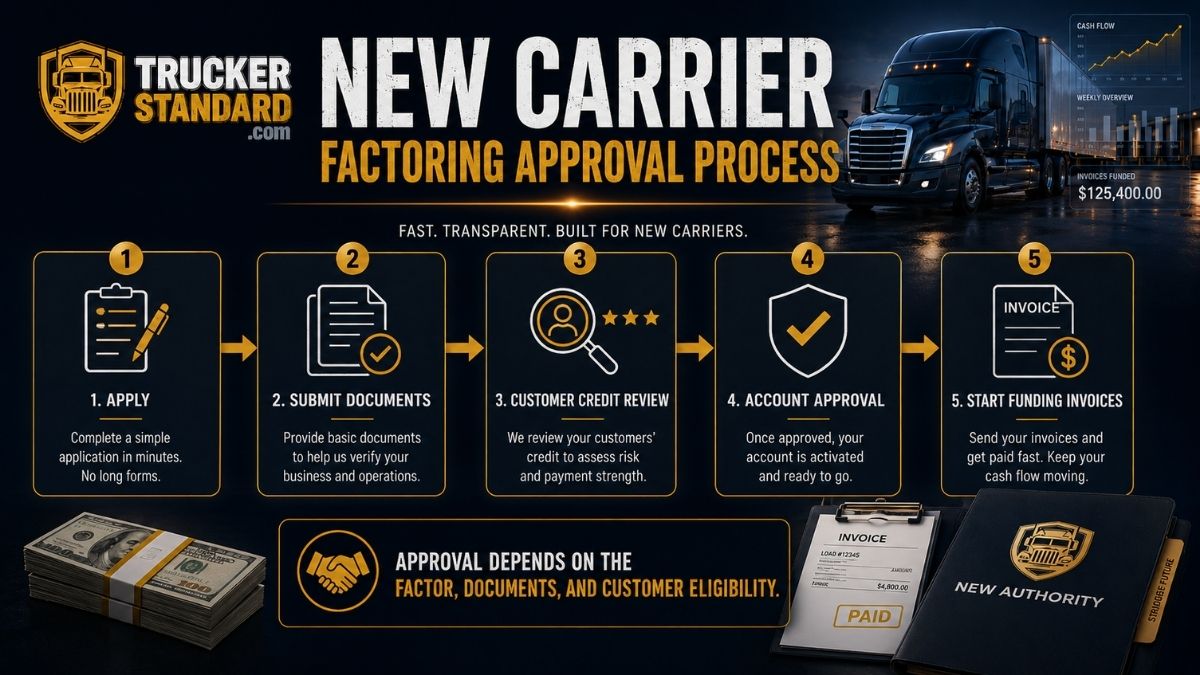
The exact workflow varies by provider, but new-authority factoring usually follows this sequence.
Provide company, owner, authority, banking, insurance, and expected invoice information.
The factor reviews legal business records, tax information, authority, insurance, and banking details.
The factor evaluates the brokers or shippers that will pay the invoices and may assign credit limits.
Read the rates, recourse rules, minimums, renewal, exclusivity, reserve, and termination terms.
After onboarding, submit the invoice packet and wait for verification and funding under the contract.
Documents Needed for New Carrier Factoring
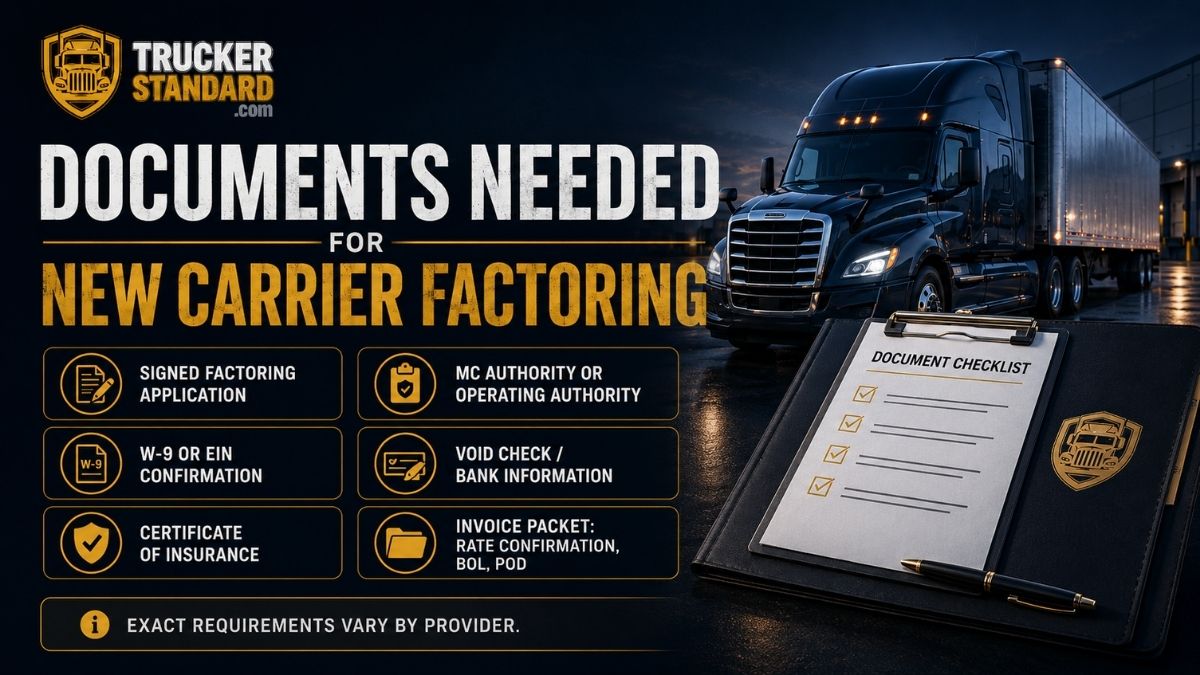
Requirements vary, but providers commonly request documentation that verifies the carrier, its authority, its banking information, and each completed load.
Company ownership, contact information, expected volume, customers, and requested funding details.
MC or USDOT authority information showing that the carrier is authorized for its operation.
Tax identification documents used to verify the legal business and taxpayer name.
Proof of active insurance matching the carrier and authority information.
A voided check, bank letter, or other verification for the account receiving funds.
Invoice, rate confirmation, signed bill of lading or proof of delivery, and load-specific receipts.
Why Broker Credit Matters More Than Carrier Age
A factor expects repayment from the broker or shipper, so the customer behind the invoice is a central part of the approval decision.
The factor evaluates the broker’s or shipper’s payment history, financial strength, and risk.
The load must usually be completed, undisputed, properly documented, and payable by an approved customer.
A factor may approve the customer but limit how much outstanding invoice exposure it will fund.
Providers verify invoice authenticity, payment instructions, and whether the receivable was already assigned.
Names, authority, insurance, bank details, invoice data, and delivery documents should match.
Even an approved account can reject invoices that do not satisfy the written agreement.
A Factoring Account Does Not Guarantee Every Invoice
An Invoice May Be Eligible When
- The customer is approved and within its credit limit.
- The load has been completed and accepted.
- The invoice packet is complete and accurate.
- There is no known dispute, offset, duplicate assignment, or fraud concern.
- The invoice complies with the factoring agreement.
Funding May Be Delayed or Refused When
- The broker or shipper is not approved.
- The credit limit has already been reached.
- The BOL, POD, rate confirmation, or invoice has errors.
- The load is disputed or subject to a claim.
- The receivable was previously assigned or paid elsewhere.
How Much Does Factoring Cost for a New Carrier?
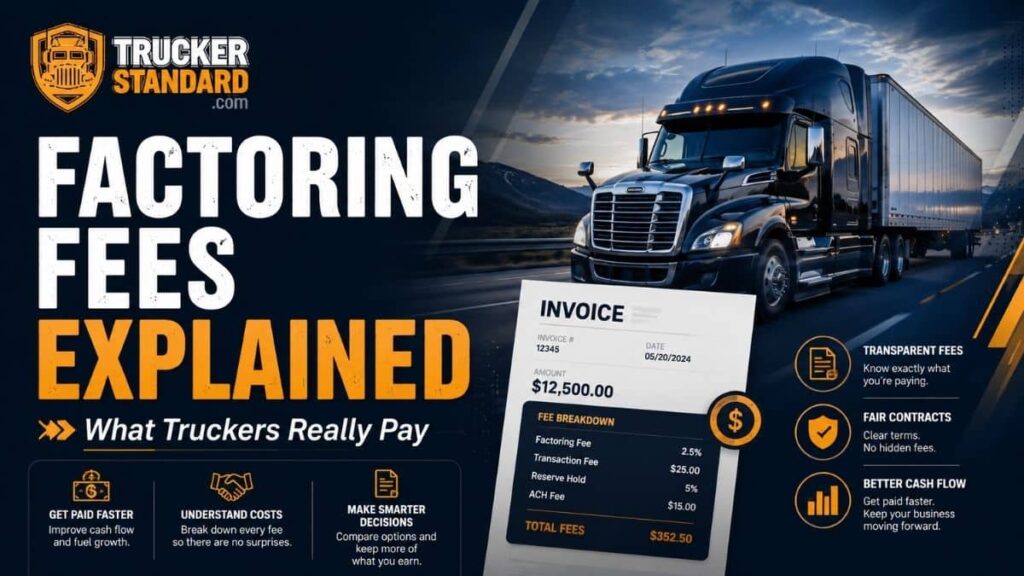
Provider educational materials describe broad factoring fee ranges around 1% to 5%, but a startup carrier’s actual quote depends on the customers, volume, payment timing, advance structure, and contract.
The percentage charged to purchase or advance against the invoice.
The allocation of nonpayment risk can affect price and chargeback exposure.
Tiered pricing may become more expensive as the invoice remains unpaid.
ACH, wire, setup, invoice, UCC, minimum-volume, reserve, renewal, or termination costs may apply.
Expected and actual monthly volume can affect the quote and minimum requirements.
The upfront percentage is separate from the factoring fee and may leave a reserve.
Do Not Compare Only the Headline Rate
Our fee guide explains flat pricing, tiered rates, reserves, transfer costs, minimum volume, and termination charges.
Read Factoring Fees Explained7 Contract Questions New Carriers Should Ask
A fast approval does not make an agreement safe. Ask these questions in writing before assigning invoices.
1. Is the agreement recourse?
Understand exactly when an unpaid invoice can be charged back or repurchased.
Ask: Which nonpayment events remain my responsibility?2. Is every invoice required?
Some contracts allow selective factoring; others require all invoices or all invoices from an assigned customer.
Ask: Can I choose which eligible invoices to factor?3. Is there a monthly minimum?
A minimum-volume clause can create charges when a new authority has a slow month.
Ask: What happens if my volume is lower than projected?4. How does renewal work?
Automatic renewal may extend the agreement unless cancellation notice is sent within a specific window.
Ask: What is the exact notice deadline and method?5. What are all additional fees?
Transfer, invoice, setup, UCC, reserve, minimum, and termination charges can change the real cost.
Ask: Can I receive the complete fee schedule?6. How are reserves released?
If the provider uses a reserve, confirm when it is released and which deductions can be made.
Ask: Show me a complete settlement example.7. How is the UCC released?
A UCC filing can affect your ability to change providers or obtain other financing.
Ask: How quickly is the release filed after termination?Bonus: What support is included?
Credit checks, collections, invoice support, fuel programs, and account tools can affect total value.
Ask: Which services are included and which cost extra?Common New-Carrier Factoring Mistakes
- Signing the first agreement offered because cash is urgently needed.
- Accepting a load before checking whether the broker is approved.
- Assuming non-recourse means every type of nonpayment is covered.
- Ignoring monthly minimums during the carrier’s startup period.
- Submitting mismatched authority, insurance, banking, or invoice information.
- Choosing only by the lowest advertised percentage.
- Missing an automatic-renewal cancellation deadline.
- Factoring low-margin freight that becomes unprofitable after fees.
- Failing to keep clean copies of the rate confirmation and signed POD.
- Not understanding the factor’s UCC filing and release process.
When Factoring Can Help a New Authority
It May Help When
- You need cash for fuel and operating costs before brokers pay.
- Your approved customers use long payment terms.
- The total cost still leaves a healthy load margin.
- Credit checks help you avoid weak or slow-paying brokers.
- Faster cash allows you to accept additional profitable loads.
- The agreement has flexible volume and cancellation terms.
It May Be a Poor Fit When
- You have enough reserves to wait for normal payment.
- The factoring cost removes too much profit from your loads.
- The contract requires volume you cannot reliably produce.
- The agreement contains a long term or expensive termination.
- Your main customers pay quickly through low-cost quick pay.
- You have not calculated the total effective cost.
Should You Factor or Wait for Payment?
Compare the visible factoring fee with the borrowing, missed-load, repair, and cash-flow costs your new carrier may face while waiting.
Compare Factoring vs WaitingCompare Providers That Fit Your New Carrier
Look beyond funding speed. Compare public pricing, recourse structure, contract length, minimum volume, customer-credit tools, additional fees, and how clearly each provider explains its agreement.
Related Factoring Guides
Understand the invoice process, documents, recourse terms, and customer payment flow.
Review factoring rates, tiered fees, reserves, minimums, and contract charges.
Compare providers by pricing, recourse terms, contracts, and carrier fit.
Factoring for New Carriers Questions
Can a brand-new trucking company qualify for factoring?
Yes, some factoring companies work with startup carriers and new authorities. Approval usually depends on business documentation, eligible invoices, the credit quality of the brokers or shippers, and the provider’s underwriting rules.
Does a new carrier need strong personal credit?
Freight factoring generally focuses more heavily on the creditworthiness of the customer paying the invoice than a traditional loan would. However, a factor may still review owners, liens, UCC records, business history, or other risk information.
What documents does a new carrier need for factoring?
Common requirements include an application, MC or USDOT authority information, W-9 or EIN documentation, certificate of insurance, banking verification, and complete invoice packets with rate confirmations and signed BOL or POD documents.
How quickly can a new carrier be approved?
Timing varies by provider and depends on how quickly documents, identity, authority, insurance, banking, liens, and customers can be verified. An approval estimate should not be treated as guaranteed funding for every invoice.
How much does factoring cost for a new authority?
Provider educational materials describe broad rates around 1% to 5%, but actual cost depends on customer credit, invoice volume, payment timing, advance structure, recourse terms, and additional contract charges.
Can a factoring company reject a broker?
Yes. The factor may reject a broker or shipper because of credit risk, slow payment, disputes, fraud concerns, existing exposure, or other underwriting rules.
Does factoring guarantee same-day payment?
No. Same-day funding may be available, but actual timing depends on onboarding, invoice eligibility, document quality, verification, submission cutoff, banking method, and provider policies.
Should a new carrier choose recourse or non-recourse factoring?
Neither structure is automatically best. Recourse may cost less but can return unpaid-invoice risk to the carrier. Non-recourse may cover defined customer-credit defaults, but the written agreement can exclude disputes, fraud, missing documents, offsets, or unapproved customers.
Official Sources Reviewed
- OTR Solutions — Freight factoring for new trucking authorities
- OTR Solutions — New-authority factoring, recourse, collections, and funding FAQ
- OTR Solutions — Broker credit checks and payment risk
- Apex Capital — Freight factoring process and payment timing
- Apex Capital — Factoring rates and pricing considerations
- Apex Capital — Notice of Assignment in trucking
- eCapital — How trucking companies qualify for freight factoring
- eCapital — Freight factoring, operating costs, fees, and payment timing
- DAT — Operating authority requirements for carriers