Trucking Cash Flow Guide: Keep Your Business Moving
Learn how to forecast incoming cash, control operating expenses, reduce payment delays, build working capital, and use freight factoring without sacrificing more profit than necessary.
What Is Trucking Cash Flow?
Trucking cash flow is the movement of money into and out of a carrier’s business. Positive cash flow means the company is collecting enough usable cash, at the right time, to cover fuel, payroll, insurance, equipment payments, maintenance, taxes, and other operating expenses. A trucking company can be profitable on paper and still run short of cash when customer invoices are paid weeks after the load is delivered.
A Profitable Carrier Can Still Run Out of Cash
Freight revenue may appear on the income statement before the money reaches the bank account. Meanwhile, the carrier continues paying the daily cost of operating the truck.
The American Transportation Research Institute reported that the average marginal cost of operating a truck during 2024 was $2.260 per mile. Although the overall figure declined slightly because of lower fuel costs, non-fuel operating costs rose to a record $1.779 per mile.
That distinction matters. Lower diesel prices do not automatically fix cash flow when insurance, labor, equipment, maintenance, tolls, technology, and compliance costs continue consuming working capital.
Profit Does Not Equal Cash
- Revenue may be recorded before the customer pays.
- Loan principal payments reduce cash but are not ordinary expenses on the income statement.
- Equipment purchases can consume cash even when depreciated over several years.
- Owner withdrawals can drain cash without appearing as an operating expense.
- Taxes may become payable after the revenue has already been spent.
- Unexpected repairs can create an immediate cash requirement.
How the Trucking Cash Flow Cycle Works
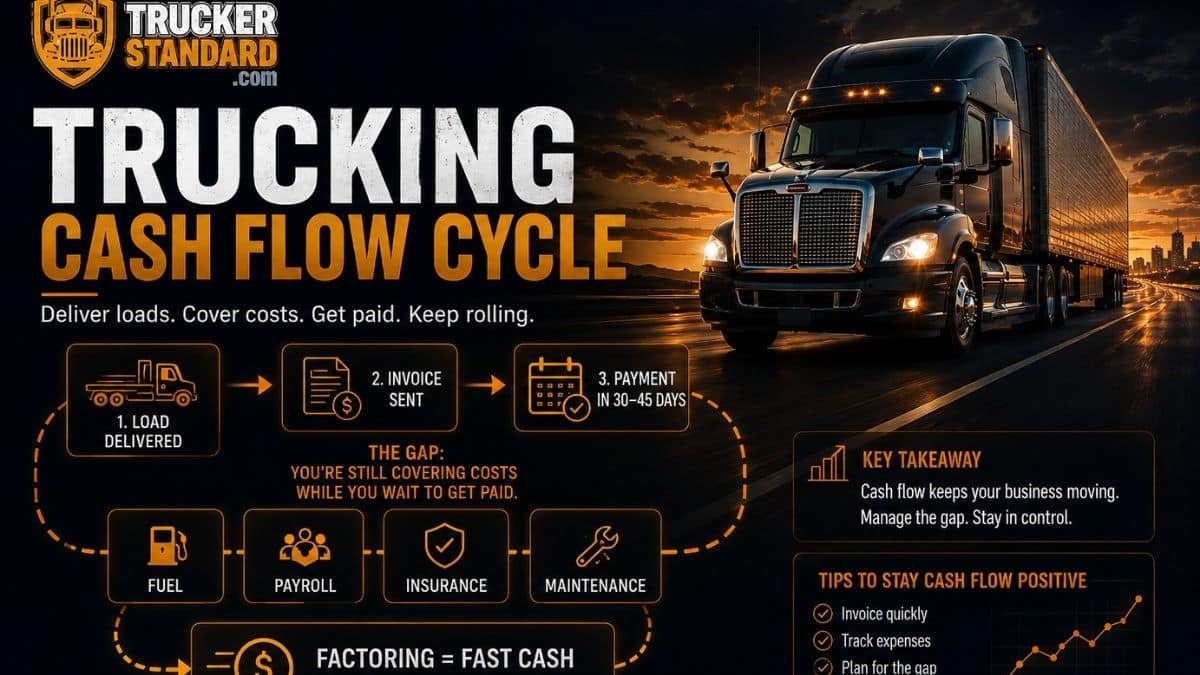
The cash gap begins when the carrier spends money to complete a load and ends when the corresponding invoice becomes available cash.
The carrier begins consuming fuel, driver time, equipment capacity, tolls, and other operating resources.
A signed proof of delivery and complete supporting paperwork are collected after delivery.
The carrier sends the invoice, rate confirmation, proof of delivery, and approved accessorial documents.
The carrier waits for standard payment, uses broker quick pay, or factors the invoice for earlier access to cash.
Know Your Real Cash Position
The current bank balance is only one number. It does not show unpaid bills, taxes, pending deposits, maintenance exposure, or money reserved for future obligations.
Cleared funds that the business can use without consuming tax, maintenance, or emergency reserves.
Freight invoices still owed by brokers, shippers, or other customers.
Bills and operating obligations the carrier must pay over the coming days and weeks.
A comparison of accounting records with cleared bank transactions and outstanding items.
Driver wages, payroll taxes, benefits, reimbursements, and contractor settlements.
Cash assigned to taxes, maintenance, deductibles, permits, or other predictable liabilities.
Calculate Cost per Mile Before Accepting Freight
A load can create revenue and still damage cash flow when the rate fails to cover total operating cost, deadhead, financing charges, and a reasonable profit margin.
Use all miles, including deadhead. Calculating only loaded miles understates the cost of operating the truck and can make a weak rate appear profitable.
| Cost category | Examples | Cash-flow effect | Recommended treatment |
|---|---|---|---|
| Variable costs | Diesel, DEF, tolls, scales, tires, driver pay, and repairs tied to mileage. | Increase as miles, loads, or utilization increase. | Track per mile |
| Fixed costs | Truck payment, trailer payment, insurance, software, permits, and office expenses. | Remain payable even during slow freight periods. | Forecast weekly |
| Periodic costs | HVUT, registration, IFTA balances, annual permits, renewals, and quarterly taxes. | Create large withdrawals on specific dates. | Accrue monthly |
| Emergency exposure | Towing, engine repair, aftertreatment failure, deductible, or cargo claim. | Can create an immediate and severe liquidity shortage. | Maintain reserve |
Factoring Cannot Rescue an Unprofitable Load
Factoring changes when the carrier receives money. It does not increase the load’s gross revenue. Because factoring fees reduce the amount retained, the load must already produce enough margin to absorb the financing cost.
Learn How Factoring Fees WorkBuild a Rolling 13-Week Cash Flow Forecast
A weekly forecast is more useful than relying only on monthly statements because trucking expenses and customer payments do not arrive evenly throughout the month.
| Forecast line | What to enter | Common mistake |
|---|---|---|
| Beginning cash | Cleared operating cash available at the beginning of the week. | Including unused credit limits or pending deposits as cash. |
| Expected collections | Individual invoices with realistic expected payment dates. | Assuming every invoice will be collected exactly on the contractual due date. |
| Operating payments | Fuel, payroll, insurance, repairs, tolls, equipment, and supplier bills. | Using monthly averages instead of actual payment dates. |
| Taxes and reserves | IFTA, HVUT, income taxes, payroll taxes, maintenance, and deductible reserves. | Spending reserved money as ordinary operating cash. |
| Ending cash | Beginning cash plus receipts minus all scheduled payments. | Waiting for a negative balance before taking action. |
Use realistic freight volume, customer payment timing, and expected operating expenses.
Reduce revenue, increase deadhead, or delay collections to test a weaker operating environment.
Add a major repair, insurance deductible, lost customer, or extended payment delay.
Owner-Operator Weekly Cash Flow Example
The following example is simplified and does not represent a universal cost structure.
$8,500 Invoiced Does Not Mean $8,500 Available
The owner-operator delivered and invoiced $8,500 in freight, but the customer will not pay during the current week. The business therefore runs short of cash even though it produced significant revenue.
Possible responses include collecting an older invoice, using broker quick pay, factoring one eligible invoice, reducing discretionary spending, or drawing from an established operating reserve.
9 Ways to Improve Trucking Cash Flow
Submit complete billing documents as soon as delivery is confirmed.
Verify that the broker or shipper received and accepted the invoice.
Monitor current, 30-day, 60-day, and overdue receivables separately.
Review MPG, idle time, route selection, fuel discounts, and out-of-route miles.
Empty miles consume fuel, driver time, and equipment capacity without generating revenue.
Keep tax, maintenance, deductible, and operating reserves separate from normal spending.
Compare brokers and shippers by actual days to payment, not only by freight rate.
Negotiate supplier terms that reduce the mismatch between collections and obligations.
Use factoring, quick pay, or credit only when faster cash creates greater value than its cost.

Speed Up Payments Before Paying for Financing
Some cash-flow delays are caused by payment terms. Others are caused by missing documents, incorrect invoices, or billing procedures that were not followed.
- Verify billing requirements before hauling the load.
- Collect signed proof of delivery immediately.
- Match the invoice to the rate confirmation.
- Attach receipts for approved accessorial charges.
- Use the broker’s required portal or billing address.
- Confirm that the invoice was received and accepted.
- Record the contractual payment date.
- Follow up before the invoice becomes seriously overdue.
An Invoice Is an Asset, Not Available Cash
Accounts receivable can appear on the balance sheet and still be unusable for fuel or payroll. The invoice becomes spendable cash only after the customer pays or the receivable is financed or sold.
Compare Factoring vs WaitingBuild Separate Cash Reserves
There is no universal reserve amount for every owner-operator or fleet. The correct target depends on actual fixed costs, equipment condition, insurance deductibles, debt, freight stability, and customer payment speed.
Tires, brakes, preventive service, towing, engine repairs, aftertreatment systems, and major mechanical failures.
Income taxes, payroll taxes, IFTA balances, HVUT, registrations, and state obligations.
Fixed obligations during slow freight periods, customer delays, downtime, or lost utilization.
A carrier with $4,500 in unavoidable weekly obligations would need $18,000 to cover four weeks. That operating reserve would be separate from money reserved for taxes or a major repair.
When Factoring Can Improve Trucking Cash Flow
Freight factoring converts an approved unpaid invoice into earlier cash. The factor collects the invoice and deducts the charges defined by the agreement.
Factoring May Make Sense When
- The carrier is growing faster than customers pay.
- Fuel or payroll is due before invoices will be collected.
- Early funding prevents lost revenue-producing loads.
- The total cost is lower than the cost of the cash shortage.
- The contract permits the flexibility the carrier needs.
- Customer credit monitoring provides additional operational value.
Factoring Is a Poor Fix When
- Freight rates do not cover actual operating cost.
- Owner withdrawals are draining the business.
- Every invoice must be factored only to survive ordinary expenses.
- The agreement contains unacceptable minimums or termination charges.
- The carrier does not understand recourse obligations.
- Factoring costs eliminate the remaining load margin.
| Payment option | Typical purpose | Main advantage | Main limitation |
|---|---|---|---|
| Standard payment | Wait for the broker or shipper to pay under normal terms. | No factoring or quick-pay fee. | The carrier must fund the entire payment gap. |
| Broker quick pay | Accelerate payment on loads from a specific broker. | Can be simple and load-specific. | Pricing, speed, and availability vary by broker. |
| Freight factoring | Sell or assign eligible invoices for earlier funding. | Can provide predictable access to cash across multiple approved customers. | Fees, reserves, recourse, contract terms, and UCC filings require review. |
| Business credit line | Borrow only when temporary working capital is needed. | May allow the carrier to keep direct control of customer collections. | Approval, interest, collateral, guarantees, and repayment obligations apply. |
| Cash reserve | Self-fund routine payment delays and temporary shortages. | No external financing fee. | Requires time and profitability to build. |
Review More Than the Advertised Rate
- Base factoring or discount rate.
- Flat or time-based pricing structure.
- Recourse and non-recourse definitions.
- Advance rate and reserve percentage.
- ACH, wire, fuel-card, or same-day fees.
- Monthly minimum-volume requirements.
- Contract length and automatic renewal.
- Early-termination charges.
- UCC filing and release procedures.
- Chargebacks and disputed-invoice procedures.
Improve Trucking Cash Flow in Four Weeks
Reconcile accounts, list receivables and payables, calculate cost per mile, and identify restricted reserves.
Create a rolling 13-week schedule using realistic invoice collection and payment dates.
Standardize invoicing, confirm receipt, follow up on aging accounts, and resolve documentation errors.
Fund reserves, remove low-margin freight, review financing costs, and set weekly cash targets.
Protect Cash Flow Without Ignoring Profit
Faster funding can solve a timing problem, but it should not hide weak rates, excessive expenses, poor collections, or inadequate reserves. Compare the total cost and contract terms before assigning freight invoices.
Trucking Cash Flow Questions
What is cash flow in a trucking business?
Cash flow is the movement of money into and out of the trucking business. Incoming cash includes collected freight invoices and other receipts. Outgoing cash includes fuel, payroll, insurance, maintenance, equipment payments, taxes, permits, tolls, and owner distributions.
Why can a profitable trucking company run out of cash?
Profit is recorded according to accounting rules, while cash flow depends on when money is actually collected and paid. A carrier can produce profitable loads but lack usable cash because invoices remain unpaid while operating expenses are already due.
How can an owner-operator improve cash flow?
Invoice immediately, submit complete documentation, track accounts receivable, reduce deadhead, control fuel use, calculate cost per mile, separate reserves, forecast weekly cash, and use financing only when its value exceeds its total cost.
What is a 13-week cash flow forecast?
It is a weekly projection of beginning cash, expected collections, scheduled payments, and ending cash for the next thirteen weeks. The forecast is updated every week so potential shortages can be identified before bills become due.
How much cash reserve should an owner-operator maintain?
There is no universal amount. The target should reflect actual weekly obligations, equipment condition, debt, insurance deductibles, customer payment speed, freight stability, and repair exposure.
Does freight factoring improve cash flow?
Factoring can improve short-term liquidity by converting eligible unpaid invoices into earlier cash. It does not improve the original profit of the load because factoring charges reduce the amount the carrier retains.
Is freight factoring a loan?
Traditional factoring is generally structured as the sale or assignment of accounts receivable rather than a standard installment loan. However, recourse agreements may require the carrier to repurchase or replace invoices that remain unpaid.
Can a carrier improve cash flow without factoring?
Yes. Alternatives include faster invoicing, better collections, broker quick pay, reduced deadhead, fuel-cost control, supplier terms, a responsible business credit line, lower owner withdrawals, and stronger cash reserves.
Sources Reviewed
- American Transportation Research Institute — 2025 Operational Costs Update
- ATRI — Operational Costs of Trucking Research
- U.S. Small Business Administration — Manage Your Finances
- U.S. Energy Information Administration — Gasoline and Diesel Fuel Update
- DAT Freight & Analytics — Freight Load Factoring
- DAT Freight & Analytics — Invoice Factoring for Truckers
- DAT Freight & Analytics — Recourse vs Non-Recourse Factoring
Editorial note: This guide is educational and does not provide legal, tax, accounting, or individualized financial advice. Costs, payment periods, factoring rates, reserves, and contract terms vary by carrier, customer, and provider.
Affiliate disclosure: TruckerStandard may earn compensation when readers use certain links on this website. Compensation does not determine our analysis. Carriers should review the complete written agreement before purchasing or financing any service.

Published July 11, 2026. Wilson Borjas researches trucking business services, freight factoring, fleet technology, compliance tools, and financial resources for owner-operators and small fleets.