Factoring Fees Explained
Learn how trucking factoring fees work, what affects your rate, which extra charges to review, and how flat and tiered pricing compare.
Factoring Fees Explained: What Truckers Really Pay
Factoring fees explained in simple terms: they are the costs a factoring company charges for purchasing or advancing against eligible freight invoices. Provider educational materials commonly describe broad rates of approximately 1% to 5% of invoice value, although some providers cite ranges closer to 2% to 5% for freight factoring. The actual cost depends on customer credit, invoice volume, payment time, advance structure, recourse terms, and additional contract charges.
Factoring Fee Example on a $5,000 Invoice
This simplified example shows the base factoring fee only. Your agreement may include reserves, transfer fees, minimums, or other charges.
Why the true cost may be higher
A quote may also include ACH or wire charges, invoice-processing fees, account setup, minimum-volume requirements, reserves, UCC-related costs, or early-termination fees. Compare the total amount you expect to pay, not only the advertised percentage.
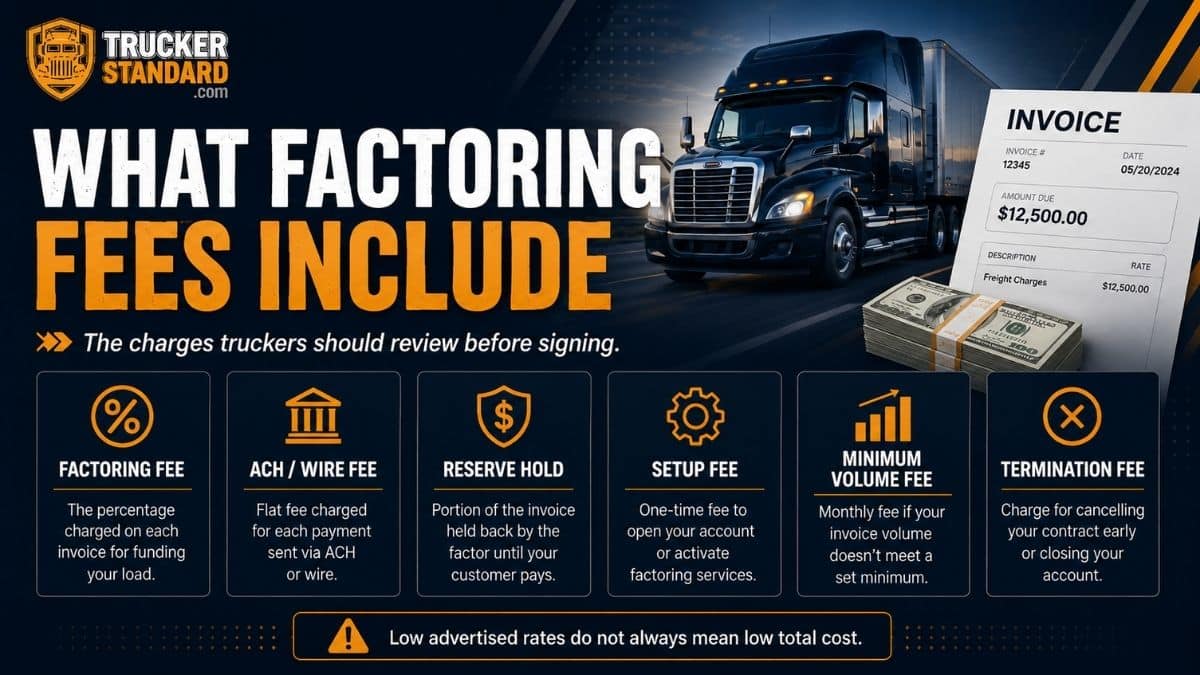
What Factoring Fees Can Include
Not every provider charges every fee. This section keeps factoring fees explained clearly by separating the headline rate from the additional charges that should be checked in the quote and agreement.
The main percentage charged for purchasing or advancing against the invoice.
A charge for transferring funded money to your bank account or another destination.
A portion of the invoice held until the customer pays, minus applicable fees or adjustments.
A possible account-opening, underwriting, documentation, or periodic review charge.
A fee or pricing consequence when monthly invoice volume falls below the contract minimum.
A charge for ending the agreement before the term or notice requirements are satisfied.
Flat Rate vs Tiered Factoring Fees
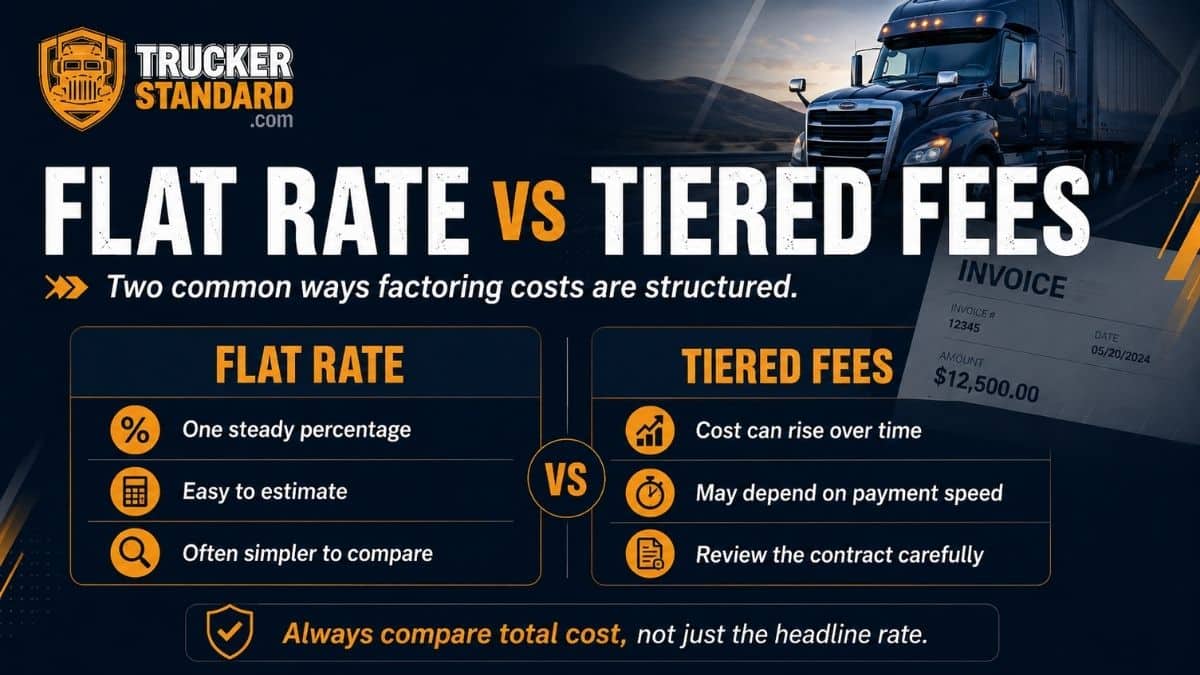
The labels are not standardized across every provider, so ask for examples using your expected invoice age and customer payment pattern.
| Feature | Flat rate | Tiered or time-based rate |
|---|---|---|
| Basic structure | One stated percentage may apply to the invoice under the quoted conditions. | The fee may increase as the invoice remains unpaid for additional periods. |
| Predictability | Often easier to estimate before submitting an invoice. | Final cost depends more heavily on how quickly the customer pays. |
| Potential advantage | Simple comparison and budgeting when the agreement is genuinely all-inclusive. | May start lower for customers that consistently pay quickly. |
| Main caution | A flat rate can still exclude transfer, minimum, reserve, or contract charges. | A slow-paying broker can make the invoice more expensive than expected. |
What Affects Your Factoring Rate?
Official provider materials consistently identify risk, volume, time, and advance structure as important pricing factors.
The factor evaluates the brokers or shippers responsible for paying the invoices.
Higher and more consistent volume may qualify for different pricing.
Longer customer payment periods can increase the factor’s cost and risk.
A higher upfront advance may influence the rate or reserve structure.
Who bears defined nonpayment risk can affect price and eligibility.
Term length, minimum volume, exclusivity, and service bundle can influence the quote.
The Factoring Fee Is Not the Same as the Advance Rate
These terms describe different parts of the transaction.
| Term | What it means | Why it matters |
|---|---|---|
| Factoring fee | The cost charged for the factoring service, usually expressed as a percentage or discount. | This reduces the total amount your business ultimately keeps. |
| Advance rate | The percentage of invoice value paid to the carrier before the customer pays. | It determines how much cash is available immediately. |
| Reserve | The remaining portion held until the customer pays, subject to fees and adjustments. | A high reserve can reduce immediate liquidity even when the stated fee looks low. |
How to Calculate the True Cost of Factoring
Ask Each Provider For
- The complete written fee schedule.
- A sample calculation using your average invoice.
- The advance rate and reserve process.
- The fee at 15, 30, 45, 60, and 90 days if pricing is tiered.
- Monthly minimums and volume commitments.
- Contract term, renewal notice, and termination formula.
- ACH, wire, UCC, setup, and documentation charges.
Avoid Comparing Only
- The lowest rate shown in an advertisement.
- An introductory rate without the standard rate.
- The advance amount without considering the reserve.
- Same-day funding without the transfer charge.
- Non-recourse language without reading exclusions.
- A verbal promise that does not appear in the agreement.
Compare Total Cost Before You Sign
A factoring company with a slightly higher headline rate may be less expensive overall if it avoids transfer fees, minimums, reserves, or restrictive contract penalties. Model your actual invoice volume and customer payment speed before choosing.
Related Factoring Guides
Learn how the process works, which documents are required, and how recourse terms differ.
Compare faster cash access with the cost and obligations of a factoring agreement.
Compare providers by published pricing, contracts, recourse terms, and funding process.
Factoring Fee Questions
Factoring fees explained: what is a typical trucking factoring fee?
Official provider educational materials commonly describe broad ranges of approximately 1% to 5% of invoice value, while some freight-focused pages cite 2% to 5%. Your actual quote depends on customer credit, invoice volume, payment time, recourse terms, advance structure, and the agreement.
What is the difference between a factoring fee and an advance rate?
The factoring fee is the service cost. The advance rate is the percentage of invoice value paid before the customer pays. The unadvanced portion may be held as a reserve and released later, minus fees or adjustments.
Are flat-rate factoring fees always cheaper?
No. A flat rate may be easier to estimate, but it can still exclude ACH, wire, setup, minimum-volume, reserve, UCC, or termination charges. Compare the total expected cost.
Why do some factoring fees increase over time?
Under tiered or time-based pricing, additional fees may apply as the invoice remains unpaid for longer periods. Slow customer payment can therefore increase the final cost.
Does non-recourse factoring cost more?
It may. Non-recourse arrangements can shift defined customer-credit risk to the factor, but coverage is limited by the contract and may exclude disputes, fraud, missing paperwork, offsets, or unapproved customers.
Can trucking factoring have hidden fees?
Some agreements include charges beyond the headline rate, such as ACH, wire, invoice, setup, due-diligence, monthly minimum, UCC, reserve, renewal, or termination charges. Ask for the complete written fee schedule.
How can an owner operator compare factoring quotes?
Use the same invoice amount, monthly volume, customer-payment timeline, transfer method, and contract period for every quote. Include all recurring and one-time charges in the calculation.
Can a factoring company change the rate?
Rate changes depend on the agreement. Pricing may change because of volume, customer risk, invoice age, service usage, renewal terms, or other contract provisions.
Official Sources Reviewed
- Apex Capital — Factoring rate, advance rate, and fee ranges
- Apex Capital — Factoring advance rates explained
- Apex Capital — Advance rates, reserves, and factoring agreements
- DAT — Freight factoring rates and pricing factors
- DAT Outgo — Freight factoring costs and additional fees
- eCapital — Freight factoring fees and advance rates
- eCapital — Total cost of a factoring agreement
- eCapital — Factors that affect factoring rates and costs
- OTR Solutions — Recourse and non-recourse risk differences