What Is Trucking Factoring?
Learn how trucking factoring works, what it costs, which documents carriers need, and the difference between recourse and non-recourse factoring.
What Is Trucking Factoring? A Simple Definition
If you are asking what is trucking factoring, it is a financing arrangement in which a carrier sells an eligible freight invoice to a factoring company for earlier access to cash. The factor pays according to the agreement, collects payment from the broker or shipper, and charges a factoring fee. It is a sale of accounts receivable, not a traditional installment loan.
How Does Trucking Factoring Work?
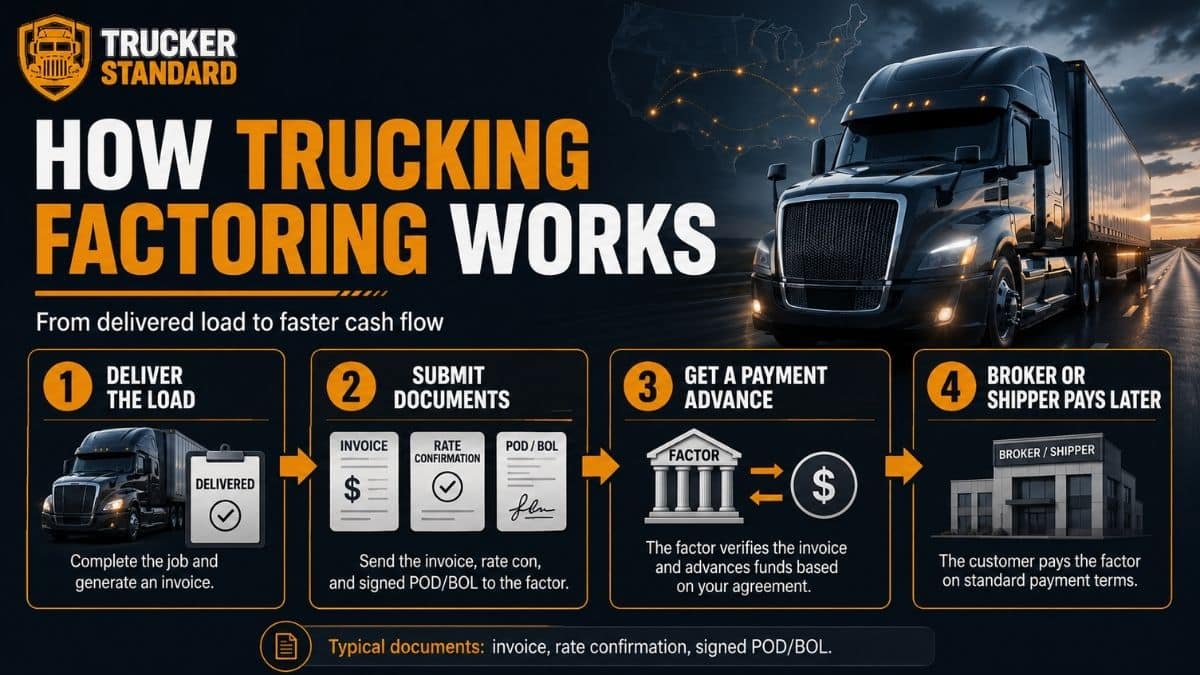
The exact review and funding process varies by provider, but most freight factoring follows the same general sequence.
Complete the shipment and obtain the signed delivery paperwork required for invoicing.
Send the invoice, rate confirmation, signed BOL or POD, and any required supporting receipts.
The company checks the documents, customer eligibility, invoice details, and contract requirements.
The broker or shipper sends payment to the factoring company under the notice-of-assignment instructions.
What Does Factoring Look Like on a Real Invoice?
The following example is simplified. Actual funding structures may use a full net purchase price or an advance-and-reserve model.
What this example does not include
Some agreements may include reserves, ACH or wire charges, invoice-processing charges, minimum-volume requirements, fuel-card fees, or early-termination costs. A low advertised rate does not always equal the lowest total cost.
What Documents Do Trucking Factoring Companies Need?
Requirements vary by provider and load. These are common documents used to verify that the freight was completed and invoiced correctly.
The invoice identifies the carrier, customer, load, amount due, and payment terms.
The rate confirmation documents the agreed payment and important load terms.
The bill of lading or proof of delivery helps confirm that the shipment was delivered.
Scale tickets, lumper receipts, detention records, or other load-specific paperwork may be required.
Onboarding may require active authority, insurance, W-9 information, banking details, and company records.
An NOA tells the broker or shipper to send payment to the factoring company rather than directly to the carrier.
How Much Does Trucking Factoring Cost?
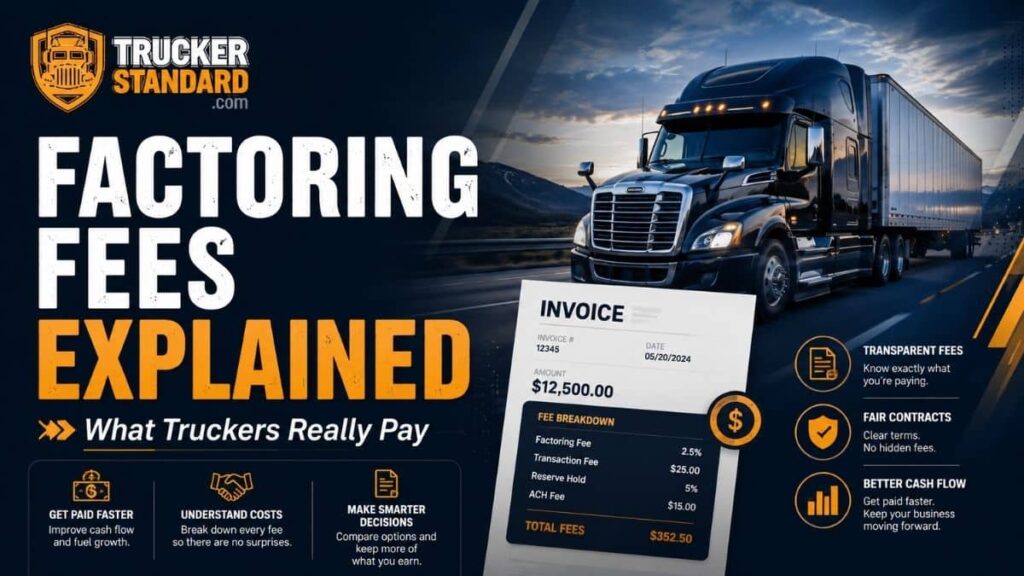
Provider educational materials commonly describe factoring fees in a broad range of approximately 1% to 5% of invoice value. Your actual cost can differ substantially.
The percentage charged for purchasing or advancing against the invoice.
The broker or shipper’s creditworthiness can affect approval, pricing, and recourse terms.
Higher or more consistent invoice volume may affect the quote and contract structure.
Longer customer payment periods may affect the factor’s cost and risk calculation.
Risk allocation can influence price, eligibility, and the events that trigger a chargeback.
Review ACH, wire, documentation, minimum, reserve, renewal, UCC, and termination terms.
Recourse vs Non-Recourse Factoring
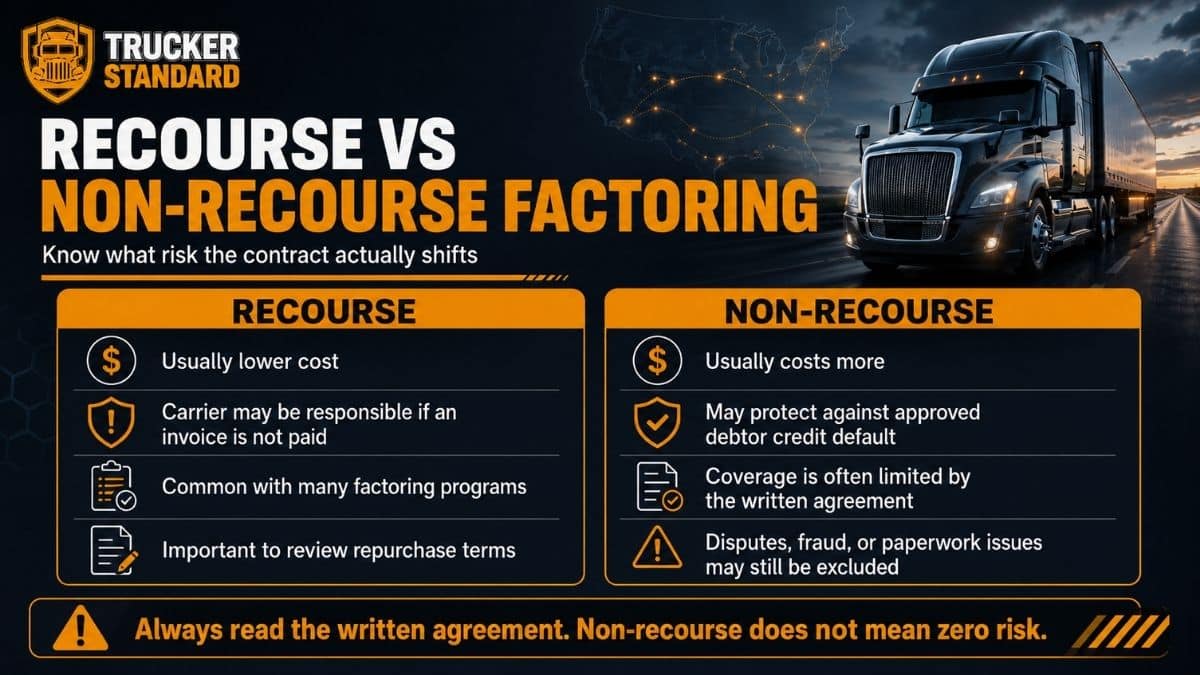
The labels describe who may ultimately bear certain nonpayment risks. The written contract controls the actual protection.
| Factor | Recourse factoring | Non-recourse factoring |
|---|---|---|
| Basic risk structure | The carrier may have to repurchase or replace an invoice that remains unpaid under the contract. | The factor may assume defined customer-credit default risk for eligible invoices. |
| Typical cost direction | Often less expensive, depending on the provider and customer risk. | May cost more because the factor accepts additional defined risk. |
| Important limitation | The repurchase window and triggering events must be reviewed carefully. | Coverage may exclude disputes, fraud, offsets, missing documents, or unapproved customers. |
| Best question to ask | Exactly when can the factor charge an invoice back to me? | Which specific nonpayment events are covered, and which are excluded? |
Benefits and Risks of Trucking Factoring
Potential Benefits
- Earlier access to cash after completing eligible loads.
- More predictable timing for fuel, payroll, insurance, and maintenance expenses.
- Customer-credit checks and accounts-receivable support may be included.
- Qualification may depend more on customer credit than on the carrier’s operating history.
- Some providers offer fuel cards, load tools, or invoicing integrations.
Potential Risks
- Factoring reduces the net amount collected from each invoice.
- Extra fees can make the real cost higher than the headline rate.
- Long contracts, automatic renewals, and exclusivity can limit flexibility.
- Recourse arrangements may return unpaid-invoice risk to the carrier.
- Factoring improves timing but does not make an unprofitable load profitable.
Factoring vs Broker Quick Pay
Quick pay and factoring can both shorten the wait for payment, but they are not identical.
| Feature | Factoring | Broker quick pay |
|---|---|---|
| Who provides payment? | A third-party factoring company purchases or advances against eligible invoices. | The broker accelerates its own payment for that load. |
| Coverage | May cover invoices from multiple approved brokers or shippers. | Applies only when the specific broker offers the option. |
| Contract considerations | May involve recourse, minimums, exclusivity, renewals, and UCC filings. | Usually load- or broker-specific, but the broker’s terms still apply. |
| Best comparison method | Calculate the total effective cost across your expected invoice mix. | Compare the broker’s fee and payment speed for individual loads. |
Common Factoring Mistakes
- Choosing a provider only because it advertises the lowest percentage.
- Assuming non-recourse means every unpaid invoice is protected.
- Ignoring automatic renewal and cancellation notice periods.
- Not asking whether monthly minimums or exclusivity apply.
- Submitting incomplete or inconsistent delivery documents.
- Failing to confirm that the broker or shipper is approved.
- Overlooking ACH, wire, invoice, UCC, or early-termination charges.
- Using faster payment to hide weak rates or unprofitable loads.
When Can Factoring Make Sense?
It May Help When
- You regularly wait weeks for approved customers to pay.
- Fuel and operating expenses are due before invoice payments arrive.
- You understand the complete cost and still preserve an acceptable margin.
- You value credit checks or outsourced accounts-receivable support.
- The agreement is flexible enough for your current business stage.
It May Not Be the Best Fit When
- Your customers already pay quickly and reliably.
- The total fee would eliminate too much of the load’s profit.
- You have sufficient reserves to wait for normal payment terms.
- The proposed contract contains restrictive renewal or termination clauses.
- You have not modeled the cost using your actual invoices.
Compare the Contract, Not Just the Rate
Review total fees, recourse triggers, customer eligibility, contract length, automatic renewal, minimum volume, funding cutoffs, and UCC release terms before choosing a provider.
Related Trucking Factoring Guides
Learn how rates, reserves, transfer fees, minimums, and contract charges affect total cost.
Compare faster cash flow with the fees, contract obligations, and tradeoffs of factoring.
Compare providers by public pricing, contracts, recourse structure, funding process, and fit.
Trucking Factoring Questions
Is trucking factoring a loan?
Generally, freight factoring is structured as the sale or assignment of eligible accounts receivable rather than a traditional installment loan. The signed agreement determines the legal and financial terms.
How quickly can trucking factoring provide payment?
Many providers advertise same-day or faster options, but timing depends on customer approval, document quality, invoice verification, submission cutoff, banking method, and account status.
What documents are normally required?
Common documents include the invoice, rate confirmation, signed bill of lading or proof of delivery, and any load-specific supporting paperwork. Onboarding also requires business, banking, authority, tax, and insurance information.
How much does freight factoring cost?
Provider educational materials commonly describe broad rates of approximately 1% to 5%, but the real cost depends on customer credit, invoice volume, payment terms, recourse structure, contract provisions, and additional fees.
What happens if the broker does not pay?
It depends on the contract. Under recourse terms, the carrier may have to repurchase or replace the invoice. Non-recourse protection may cover defined customer-credit defaults but can exclude disputes, fraud, offsets, missing paperwork, or unapproved customers.
Can a new trucking company use factoring?
Some factors work with new authorities because approval often depends substantially on the credit quality of the broker or shipper. The carrier must still satisfy onboarding, authority, insurance, documentation, and customer-eligibility requirements.
Can I choose which invoices to factor?
Some providers permit selective factoring, while others impose exclusivity, customer-level requirements, or minimum volume. Confirm this in the written agreement before signing.
Is factoring better than broker quick pay?
Neither is universally better. Compare cost, payment speed, customer coverage, flexibility, contract obligations, and whether the service applies across multiple brokers.
Official Sources Reviewed
- DAT — What Is Freight Factoring?
- DAT — Documents and choosing a factoring company
- Outgo — Public factoring agreement and minimum document requirements
- Apex Capital — Freight Factoring Guide
- Apex Capital — Notice of Assignment explained
- OTR Solutions — Recourse and non-recourse explanation
- eCapital — Factoring rates and cost factors
- eCapital — Total cost and possible fees